




Is cloud or local AI cheaper for a business?
Cloud AI can cost less for variable workloads because you pay for usage without buying dedicated hardware. Local AI can make sense for steady workloads or offline requirements when its quality and capacity meet the job.Compare total cost per accepted task, including infrastructure and human review. Free access and open model weights do not mean free business operations.
Your company can buy an AI subscription, pay a cloud API by the token, use a free hosted model, or run an open model on its own hardware. All four can be sensible. None answers the business question by itself: what does it cost to get useful work done?
Over the past year, that question has become harder to answer from a price page. Agents can consume far more tokens than a person typing into a chat. Cached tokens can be much cheaper than fresh input. Enterprise access fees may sit alongside usage charges. And a model running on your laptop still needs memory, power, maintenance, and someone who can keep it working.
This guide examines the shift from October 2025 to October 2026, using research and product documentation checked on October 20, 2026. The practical recommendation is to compare complete workflows at an agreed quality level, then choose where each part should run.
Cloud versus local and paid versus free are different decisions
Cloud or local describes where inference happens. Paid or free describes how someone charges you. Open weights describes access to the model's parameters, subject to its license. These categories overlap.
| Option | Where the model runs | What the business pays for | Useful starting point |
|---|---|---|---|
| Free hosted tier | Provider infrastructure | No direct token charge within the offer; limits and terms apply | Learning and low-risk prototypes |
| Business subscription | Usually provider infrastructure | Seats, included allowances, and possible extra usage | Staff writing, research, and collaboration |
| Metered cloud API | Provider infrastructure | Model usage, tools, and other service charges | Connected apps and variable demand |
| Self-hosted cloud model | Your rented infrastructure | Compute capacity plus operations | Controlled deployments with a capable technical owner |
| Local open-weight model | Your devices or on-premises servers | Hardware, electricity, software operations, and review | Tested offline or repeatable internal workloads |
A locally installed coding agent can still call a paid cloud model. An open model served through a hosted API is still cloud inference. Ollama, for example, supports local execution alongside paid cloud models; its current cloud plans use credits while local runs have no platform usage limit. Ollama pricing and usage terms.
Start by identifying the actual endpoint, model, and billing account. The location of the app icon tells you very little about where the computation or invoice lives.
OneWave AI / Interactive research explorer
The AI token economy, in one view
Explore the evidence. Change the economics. Find what matters for your team.
>1.3 → >3.2 quadrillion
Quadrillion monthly tokens · Google surfaces · Hover or focus the chart for values
Why a business cares: Include automated processes alongside employee chat when planning capacity.
Inspect data, sources, and limitations
Reported lower thresholds, not exact totals. Google surfaces include more than paid Cloud; these are not global figures.
| Observation | Plotted value |
|---|---|
| Oct 2025 | 1.3 |
| May 2026 | 3.2 |
What changed in AI token usage over the past 12 months?
1. The workload grew beyond the chat window
In its Q3 2025 remarks, Google reported processing over 1.3 quadrillion tokens per month across its surfaces. At I/O in May 2026, it reported over 3.2 quadrillion monthly tokens. Those are company-wide figures, not paid Cloud consumption or an industry total. Q3 2025 remarks; May 2026 keynote.
The same May keynote said over 375 Google Cloud customers had each processed more than one trillion tokens over the preceding 12 months. That customer statistic covers its own May-to-May window. It shows substantial enterprise-scale workloads; it does not identify how much of all AI usage belongs to businesses.
For a business, the implication is operational: a budget built around occasional employee questions can miss automated work running through applications and APIs. Count both people and processes when planning capacity.
2. Agents became major token consumers—and caching changed the bill
OpenRouter's October 8, 2026 analysis reports that agentic API keys consumed about seven times the tokens of human-classified keys in the last week of September. Cached prompt tokens accounted for just under 90% of agentic tokens in September, compared with roughly 60% in January. These are classified workloads on one routing platform, with a separate mixed category—not a census of all AI use. OpenRouter's cache analysis.
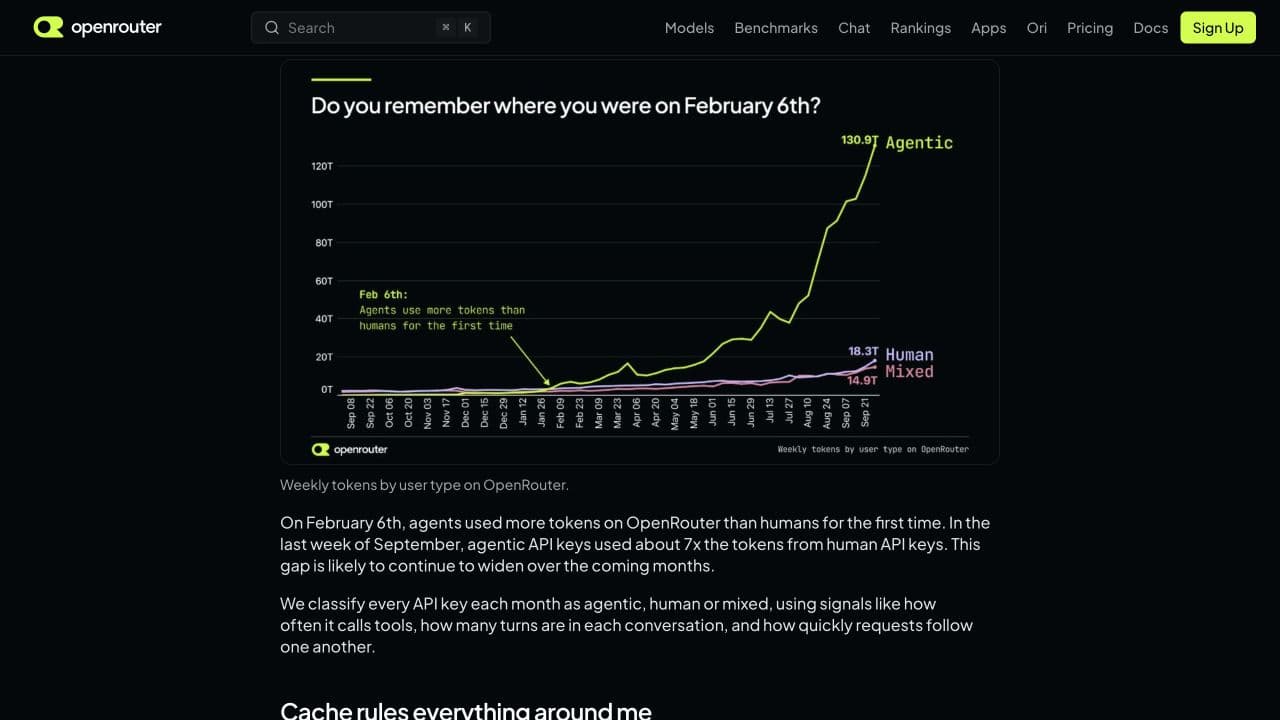
Think about a support agent reading a policy, looking up an order, checking delivery, and drafting a reply. Several steps may reuse the same policy and conversation. The customer sees one answer. The system processes a sequence of requests.
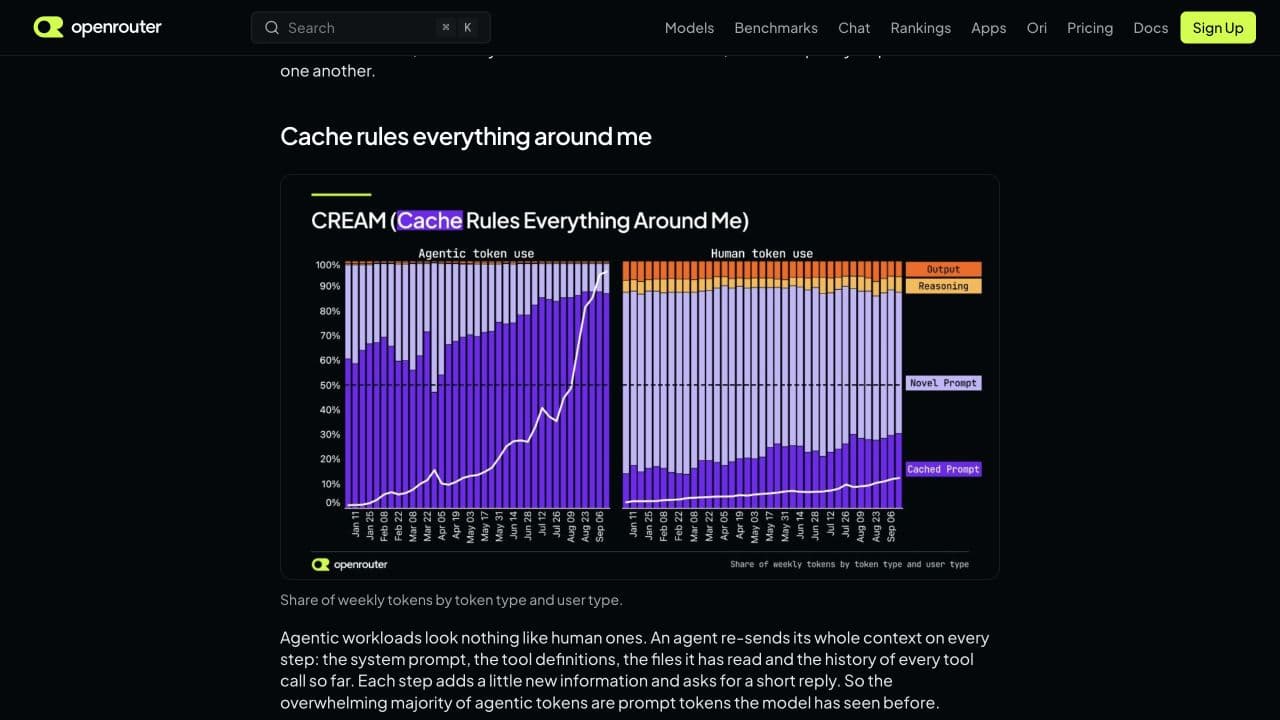
The business lesson: record fresh input, cached input, cache writes where charged, output, and tool costs separately. A large token count can coexist with an efficient workflow. A smaller count on an expensive model can produce a larger bill.
3. Comparable capability became cheaper, while teams found more work for it
Epoch AI's September 22, 2026 study estimates that the cost of achieving a given benchmark performance fell about 47% per quarter since 2023. This is a multi-year estimate published during our review period, not a measured 47% reduction in your company's bill. The authors flag benchmark relevance, incomplete data, and the assumption that users keep switching to the cheapest qualifying model. Study, methods, data, and limitations.
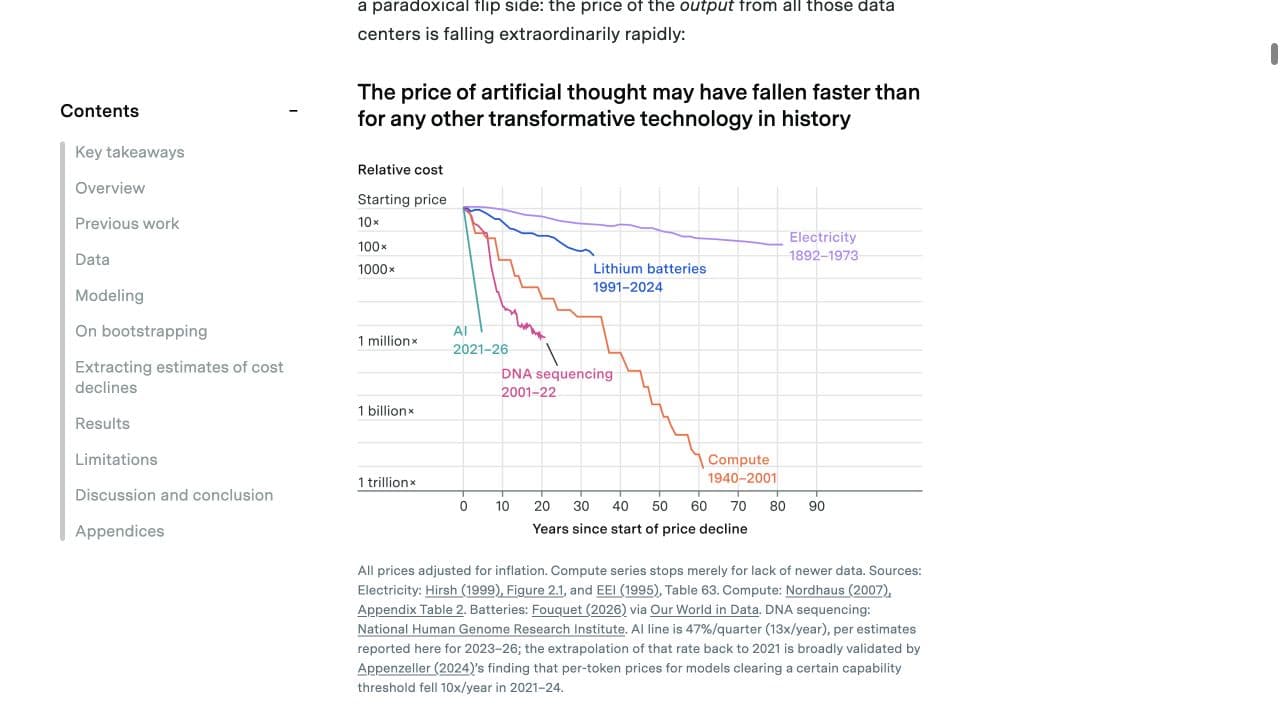
This helps explain a seemingly contradictory budget conversation. A useful level of capability can get cheaper while total spending grows because the organization automates more tasks, processes more documents, or accepts deeper reasoning. You need both a unit-cost measure and a volume measure to understand the change.
4. Enterprise access and consumption became more visibly separate
Claude's current Enterprise documentation describes a seat fee for access plus separately billed usage. Its legacy arrangements differ and transition at renewal. That is a specific vendor example, not a rule for every enterprise contract. Claude Enterprise billing documentation.
Before renewing, ask what the seat includes, how shared usage is charged, which limits stop work, and who can raise them. An enterprise agreement may be buying administration, controls, support, and capacity arrangements alongside model access. Evaluate those benefits separately from token prices.
Can we measure the share of all tokens that are paid, free, or local?
The sources reviewed here cannot establish that worldwide split.Provider reports cover their own services. Routing platforms miss direct-provider traffic and deployments outside their network. Offline local inference need not report a token count anywhere. Free and paid users may also share the same infrastructure.
OpenRouter's research explicitly identifies locally hosted and closed internal systems as outside its coverage. Its September market update also separates token-share charts from spending-share charts. Neither supports a claim such as “a third of all tokens are free” or “businesses have moved most inference on-premises.” Research scope and limitations; market update and chart definitions.
An open-model market share is especially easy to misread: those models can be running on paid cloud infrastructure. Downloads are not active users, and active users are not token volume. Keep those measures separate in procurement presentations.
Count all the work, not just the answer the user reads
For text workflows, collect input, cache activity, generated output, and any separately reported reasoning. Follow the provider's accounting: if reasoning is already included in output, adding it again overstates consumption. Also track retrieval, searches, code execution, storage, retries, and failed attempts.
Voice, image, and video complicate the comparison. Some services bill tokens, others seconds, minutes, images, or tool calls. Tokenizers also differ between models. An all-company “tokens used” number is useful for activity tracking only when its definitions are documented; it is not a universal unit of cost or value. The OpenAI rate card illustrates the mix of token-based and other charges.

Cloud AI token pricing: what does paid usage cost?
As of October 20, OpenAI's Standard short-context text rates list GPT-6 Luna at $0.10 input and $0.50 output per million tokens; GPT-6.1 Sol at $2 and $10; and GPT-6 Astra at $10 and $50. These are model prices, not a quality-equivalence claim.
For an illustrative month with one billion uncached input tokens and 100 million output tokens, the arithmetic is $150, $3,000, and $15,000 respectively. This deliberately excludes cache writes and reads, tools, taxes, hosting, and premium service tiers. Long-context and regional terms can differ. Check the current rates and conditions.
Model routing can therefore matter more than the cloud-versus-local decision. Start with the cheapest option that passes the task's quality test. Escalate difficult cases. Measure the combined cost of the first attempt, escalation, and review rather than comparing the first API call alone.
Local LLM costs: when does self-hosting break even?
Running a model on hardware you control can eliminate the hosted provider's per-token invoice. It leaves a capacity and operations budget: hardware depreciation or rental, power, support, monitoring, updates, backups, and staff time. Verify the model license for your intended use, too.
Existing hardware with spare capacity can make a local pilot attractive. A new server supporting several teams is a different purchase. Measure throughput with the model, context length, and number of simultaneous users you actually need. A model that fits in memory can still be too slow during the morning rush.
Here is a hypothetical comparison, not a hardware quote. Assume a local deployment costs $650 per month in allocated fixed costs plus $0.01 per completed task. Assume cloud costs $0.03 per completed task. Both are assumed to meet the same quality and response-time standard, with review costs equal.
| Completed tasks / month | Cloud: $0.03 × tasks | Local: $650 + $0.01 × tasks |
|---|---|---|
| 10,000 | $300 | $750 |
| 32,500 | $975 | $975 |
| 100,000 | $3,000 | $1,650 |
Break-even is $650 ÷ ($0.03 − $0.01), or 32,500 tasks per month. It holds only within the assumed local capacity and cost range. More hardware, extra review, cloud fallback, or lower cloud prices can move it substantially. If the cloud variable cost falls below the local variable cost, volume alone does not create a break-even point in this model.
Free tiers and local privacy need a closer look
Free hosted access is still hosted access. Google's Gemini Developer API pricing distinguishes data-use treatment between free and paid tiers, including whether data is used to improve products. Check the applicable service terms and account status before using business data. Gemini pricing and linked terms.
Paid cloud access does not automatically mean zero retention. OpenAI says API data is not used for training by default, while its documentation separately explains abuse-monitoring logs, application state, and eligibility for retention controls. Training policy and retention policy answer different questions. OpenAI data controls.
Likewise, a local model only keeps inference local if the surrounding workflow does. Check cloud fallback, web search, transcription, embeddings, telemetry, and connected apps. Ollama distinguishes local processing from its cloud features in its FAQ. For an offline requirement, test the complete workflow with network access disabled.
Business application: what does this mean, and why should you care?
Your AI deployment choice affects margins, delivery speed, and who owns the work when something breaks. A low token rate is useful only if the complete workflow reliably produces a result your business can use. Here is how to apply the comparison to actual operating decisions.
Protect the margin on work you sell
If an agency sells a project for a fixed fee, every extra agent run, tool call, and review hour comes out of that project's margin. If a support team handles more tickets with AI, the relevant cost is the completed, correctly resolved ticket—including escalations. Assign model and tool costs to the project or workflow rather than hiding everything in one company AI invoice.
Buy capacity that matches how the team works
A server that handles one person's demo may struggle when ten employees need it at once. A cloud service can also have rate limits or capacity constraints. Test the busiest part of the day, not just average volume. Delayed quotes, blocked agents, and slow customer replies are operating costs even when the inference invoice is small.
Keep an accountable owner and a fallback
Local deployment makes your team responsible for keeping the model available. Hosted deployment still needs someone to manage access, budgets, integrations, and provider changes. Name an owner for each workflow and decide what happens when it fails: a person takes over, work waits, or an approved alternative handles it. A fallback should respect the same data-handling requirements as the main route.
Measure business value before expanding
For an illustrative 20-person team, saving 30 minutes per person on 20 working days produces 200 hours of potential monthly capacity. At an assumed $40 per hour, that represents $8,000 of time value. It is not automatically $8,000 in payroll savings: verify that the time is actually saved, account for review and setup, and decide whether the capacity improves turnaround, service, or output.
Compare that measured benefit with the full operating cost. A $300 API bill can be excellent value for a workflow that consistently frees useful capacity. A zero-token invoice can be poor value if employees spend the week maintaining the system or correcting its answers. These are evaluation examples, not claims about a particular model or promised savings.
A practical 30-day business pilot
- Week 1—choose one task: record its current volume, handling time, error rate, and acceptance standard. Identify the data it needs.
- Week 2—compare suitable routes: run approved examples through a hosted option and, where relevant, a local candidate. Include hard cases and peak concurrency. Keep the acceptance standard the same.
- Week 3—measure the complete workflow: capture tools, retries, review, queue time, subscriptions, and infrastructure allocation.
- Week 4—decide: expand the route that meets quality and timing requirements at an acceptable cost per completed task. Document the owner, budget, and fallback before adding more users.
For implementation help, see our local AI deployment services and enterprise AI consulting. The right choice starts with your workload and operating requirements, not a preference for one hosting model.
Which business workflows fit cloud, local, or hybrid AI?
- A small team writing proposals: start with an approved business workspace and reusable instructions. Track time to an approved proposal before adding infrastructure to solve an unmeasured token-cost problem.
- High-volume ticket classification: test a small hosted model and a local candidate on the same labeled examples. Compare accepted results, queue time, exceptions, and review effort. Stable volume can strengthen the local case; variable demand can strengthen the hosted case.
- Offline document processing: prioritize a tested local workflow if offline operation is a requirement. Include extraction and storage in the test, not just the language model.
- Complex analysis or custom software: keep capable cloud models available when their quality or speed pays for the premium. A cheap attempt followed by extensive correction can be the more expensive workflow.
- An enterprise supporting several departments: consider a managed mix of employee seats, cloud APIs, and specific self-hosted workloads. Give each workflow an owner, an access policy, and a measurable completion standard.
Our recommendation is a workload-by-workload decision. Track total operating cost divided by accepted completed tasks, with failure rates and latency beside it. Include seats, inference, infrastructure, tools, review, and support. That makes the cheapest successful route visible without treating raw token consumption as productivity.
For the next step, read our team guide to choosing models and understanding usage, try seven practical business automations, or talk to OneWave about evaluating a cloud, local, or hybrid workflow with your own examples.
Frequently asked questions about cloud and local AI costs
Is local AI cheaper than a cloud API for business?
It depends on workload volume, model quality, concurrency, and operating costs. Cloud APIs avoid buying dedicated capacity; local models can be economical when suitable hardware is well utilized and the model meets the same quality and response-time requirements. Compare total cost per accepted task.
Why should a business care about AI token costs?
Token costs affect automation margins and budgets, but they are only part of AI operating cost. Include subscriptions, infrastructure, tools, review, and support, then compare the total with measured time savings, service quality, or additional capacity.
Are locally generated AI tokens free?
A local model can avoid a hosted provider's per-token invoice, but the business still pays for hardware, electricity, operations, and review. Compare total cost at the required quality, capacity, and response time.
Does open-weight AI mean local or free AI?
No. Open weights describes access to model parameters under a license. The model can run locally, on rented infrastructure, or through a paid hosted API. Hosting location and billing model are separate decisions.
What share of all AI tokens are paid, free, or local?
The reviewed public sources do not establish a worldwide split. Provider and router data cover their own services and cannot comprehensively measure offline or private deployments. Open-model share is not local-inference share.
What changed in AI usage over the past year?
The article examines growth in automated workloads, repeated context and caching, changing cost/performance, and enterprise access fees alongside consumption charges. Source-specific dates and coverage are stated rather than treated as a universal market census.
Research references and scope
Research checked October 20, 2026. The historical section reviews developments within the past year; individual studies retain their own observation windows. No worldwide paid/free/local market-share estimate is asserted. Cost examples are labeled calculations, not measured client savings.
- Epoch AI: The plunging price of thought — independent cost/performance research, with code and methodological limitations.
- OpenRouter: Cache is Crucial — observed traffic and token mix on its own platform; original screenshots reproduced above for reference.
- OpenRouter: The Token State of Play — separate definitions for volume and spending segments.
- Google Q3 2025 remarks and Google I/O 2026 keynote — company-reported scale, with distinct product-wide and Cloud-customer measures.
- OpenAI API pricing and data controls — current service rates and data-handling distinctions.
- Claude Enterprise billing — current and legacy contract arrangements.
- Ollama pricing, local/cloud FAQ, and Gemini Developer API pricing — examples showing why free, local, and open are separate labels.