



A few years ago, getting an AI model to turn a messy callback log into a usable plan could take a page of instructions. You’d tell it which columns to inspect, how to group the rows, and exactly how to write the result. Then you’d send the whole thing and fix whatever came back wrong.
Today you can hand a strong model the log, describe what’s going wrong, and ask for a plan your team can try next week. It can look for patterns, weigh possible fixes, and check whether the evidence supports its recommendation. That changes what’s worth spelling out in the prompt.
How should you prompt a reasoning model in 2026?
Describe the problem, give the model the relevant evidence, and define what a successful output looks like. State the rules it has to follow and let it choose the method. Follow up when you uncover new information or need to make a decision.
- 2022–23
- Script the taskEarly ChatGPT rewarded a clear procedure and a finished example.
- 2024–25
- Steer through conversationStart with a brief, review the draft, and give feedback one decision at a time.
- 2026
- Hand off the problemGive the model the goal, evidence, constraints, and a way to check the result.
Why tight prompts mattered when ChatGPT went public
ChatGPT’s public launch on November 30, 2022 brought prompting into everyday use. OpenAI described how sensitive that early version was to wording. A slight rephrase could turn a response that claimed ignorance into a correct answer. That was a good reason to pay attention to how you asked. OpenAI’s original ChatGPT announcement
Early models could follow patterns and carry out narrow tasks. They were less reliable at working out the intermediate steps on their own. Spelling out a procedure let a human supply the plan. A sample answer showed the model what to produce, and a fixed format made omissions easier to spot.
The familiar pattern was one big prompt and a couple of fixes. “FYI, this goes to the owner.” “Add a deadline to each item.” Our business prompt library shows that style and why it still works for jobs with a standard procedure.
Shorter follow-ups turned prompting into a conversation
ChatGPT supported follow-ups from its launch in 2022. By May 2025, OpenAI co-founder Sam Altman was describing people who had built ongoing workflows around it, with files, memory, and reusable prompts. Some of their prompts were complex. The change he pointed to was that people could keep talking to the model as their work evolved. Sequoia’s interview transcript
Short follow-ups pay off when your next decision depends on what you just saw. Ask for two approaches, pick one after seeing the trade-offs, and ask the model to check the chosen version against the source. OpenAI’s ChatGPT guidance describes this as iterative refinement. OpenAI’s ChatGPT prompting guidance
OpenClaw creator Peter Steinberger described the same shift in his own coding workflow in 2025. His Codex prompts had often become one or two sentences and a screenshot. The image gave the agent a place to start and the codebase supplied details the agent could look up as it worked. Peter Steinberger’s account
Share requirements you already know in the first message. In a 2025 study, researchers split fully specified instructions across simulated conversations and reported an average performance drop of 39% across six tasks. The experiment tested delayed disclosure of requirements in a particular set of tasks. If you’ve made several changes in a chat, consolidate the current requirements into one brief before asking for the final version. Laban et al., LLMs Get Lost in Multi-Turn Conversation
Reasoning models can work out the steps
OpenAI’s o1 was an early turning point. Released in 2024, it was trained to spend time reasoning before producing an answer. That gave the model more room to try approaches and recover from mistakes. We saw the trade-off in our first look at o1. The extra work could pay off on a difficult problem and slow down a simple one. OpenAI’s o1 research, OneWave’s o1 review
A November 2026 starting point for complex work is GPT-6.2 Astra in the OpenAI lineup or Claude Fable 5.2 in the Claude lineup. For more routine work, OpenAI positions GPT-6.2 Sol as its everyday model and Anthropic recommends starting with Claude Opus 5.5 for most coding and knowledge work. Google’s current lineup includes Gemini 4 Carbon and Argon for deep reasoning and Gemini 4 Hydrogen for faster everyday tasks. Argon is the model in the cornhole demo. OpenAI’s release, Anthropic’s release, Google’s lineup
How fast did OpenAI and Claude models improve?
ARC-AGI-2 asks models to infer a rule from a few examples and apply it to a new grid. In June 2025, OpenAI o3 and Claude Opus 4 scored in the single digits. By November 2026, both families had a model above 90% on the same benchmark version.
Agents’ Last Exam tests a different skill. It evaluates whether a model and its agent software can deliver multi-step professional work against a rubric. OpenAI reported that GPT-6.2 Astra gained 5.2 points over GPT-6 Astra in roughly 11 weeks, at under a third of the benchmark run cost. In that comparison it scored 5.5 points above Claude Fable 5.2. The Fable result excluded nine tasks that ran on a fallback model. Agents’ Last Exam, OpenAI’s reported results
These tests measure different capabilities under specific conditions. The practical question for a team is whether a model can take a complete brief and pass the same checks a person would apply to the work. As the model gets better at finding and testing its own approach, the brief can spend more of its words on the goal.
What the cornhole robot learned from a video
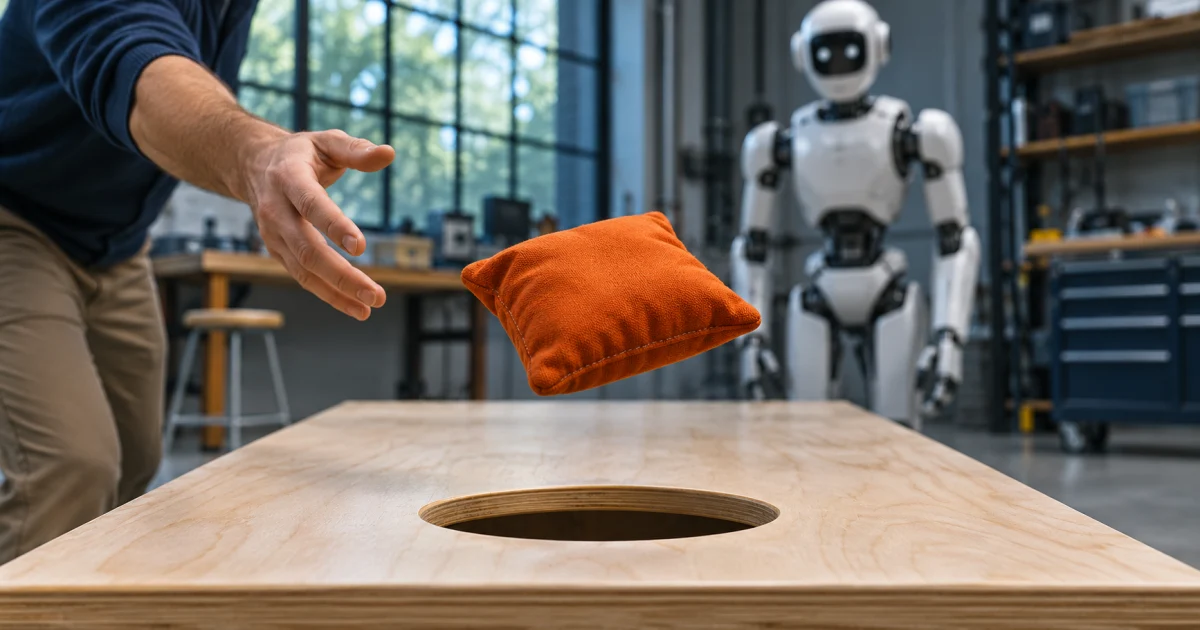
In Google DeepMind’s October 2026 demo, a video of a person throwing a beanbag conveyed the setup, the motion, and the target. Gemini 4 Argon used the footage to map the scene and write code for a MuJoCo physics simulation. That gave the system a place to try a throwing motion before using Apptronik’s Apollo humanoid. Google’s account of the trial
The first throws missed. On hardware, the system used that feedback to adjust the release. Google reported seven consecutive shots through the hole. The demonstration supplied a concrete target and the team’s setup gave the model a way to try, check, and adjust. An agent working with documents or code needs its own version of that check.
Google’s engineers tried a similar handoff on their Python Agent Development Kit. They gave Gemini 4 Argon a short performance goal plus project rules and ran it overnight. Engineers reviewed the changes and shipped two optimizations. In Google’s tests, in-memory session preparation dropped about 40% in long sessions and package import time dropped 21%. Time to the first model request stayed roughly flat. Google’s engineering write-up
What Claude built from a brief
Saltline, a playable browser game
Anthropic engineer Felix Rieseberg asked Claude Fable 5.2 for a first-person shooter with a tiny level and ambitious graphics. The playable result was Saltline, a game set in a rainy cargo port. He described it as a one-shot test with zero human feedback during the build. In his account, the run took about eight hours and cost about $550 at API prices. Claude generated the models, sounds, and textures from scratch. Play the original Saltline, Read Rieseberg’s prompt
A prototype operating system that boots on a laptop
In a separate experiment, Anthropic gave Fable 5.2 the job of designing a prototype operating system from an empty folder. Anthropic says the model coordinated more than 1,000 subagents over eight days to write, test, and review the code. The resulting system booted on a laptop and included a kernel, disk and network drivers, persistent storage, and a windowed interface. Anthropic’s write-up and demo
A small level with a specific look and an operating system that actually boots are both concrete targets. The problem can take a sentence to describe and hours or days of planning, tool use, and tests to complete. That’s the emerging division of work between the person giving the brief and the agent doing the build.
How to hand off a problem in one brief
Picture a service manager whose team is missing callbacks. She can attach the callback log and an approved handoff note that demonstrates the format. The log contains the evidence. The note shows what someone on the next shift can act on.
The brief gives the model a business decision to support and tells it what a usable answer needs to contain. It can choose how to analyze the log.
- Problem
- Customer callbacks are slipping between shifts. Find where the handoff breaks down.
- Evidence
- Use the attached callback log and an example of a handoff note our team already uses.
- Deliverable
- Draft a one-page plan we can try next week with our current team and tools.
- Success criteria
- Name an owner for each change and a measure to review Friday. Cite the log entries that support the plan and flag gaps that could change it.
The model can decide whether to group misses by time of day, job type, or who hands off to whom. If it flags the morning handoff, the manager can ask, “Which log entries support that, and what else could explain the misses?” Once she has reviewed the evidence, she can pick a change and ask for a dispatch checklist.
At review, the manager can check the cited entries against the log and ask whether the Friday measure captures the actual problem. One candidate is the share of callbacks due that week that were completed within the promised window. If the log lacks promised times, the team needs to capture them before it can use that measure.
When detailed prompt engineering still earns its place
OpenAI’s reasoning guidance recommends direct instructions and precise success criteria. With GPT-6.2, it also recommends saying which decisions the model can make and which need human input. Claude’s guidance similarly recommends clear requests and relevant examples. OpenAI’s reasoning guidance, GPT-6.2 guidance, Claude’s guidance
Specify the method when the method is part of the job. A support assistant that handles refunds needs the current policy, an escalation rule, and clear permissions. A workflow that writes to a CRM needs the exact fields and validation. For a recurring job, test the instructions on representative cases, including difficult ones. OpenAI’s model optimization guidance
For a recurring workflow, try the short brief and the structured prompt on the same sample of work. Track how often the output passes review, what kinds of errors you have to fix, and how much time the review takes. If a rule keeps preventing the same error, keep the rule. If the model produces acceptable work either way, use the version your team can maintain more easily.
We’re moving toward giving a model a problem it can own within a clear boundary. The people doing the work still know what matters, where the trade-offs are, and what counts as done. Say those things plainly, give the model access to the material it needs, and use the result to decide what to ask next.
For teams putting this into practice, see our seven examples of AI workflows for business teams or our hands-on AI training for teams.
Frequently asked questions
How do I give ChatGPT or Claude a goal?
What should I give an AI model besides a prompt?
Are short prompts better than long prompts?
Is prompt engineering still useful?
How did Google DeepMind’s robot learn to play cornhole?
Sources
- OpenAI’s November 2022 ChatGPT launch announcement
- Sam Altman’s 2025 AI Ascent interview and transcript
- Peter Steinberger’s 2025 account of prompting coding agents
- Laban et al. on how models handle instructions split across turns
- ARC Prize verified reasoning benchmarks
- UC Berkeley RDI’s Agents’ Last Exam leaderboard
- OpenAI’s guide to prompting reasoning models
- Google DeepMind’s Gemini 4 Argon and Apollo cornhole demonstration
- Felix Rieseberg’s Saltline demo and run details
- Anthropic’s operating system experiment with Claude Fable 5.2