Success StoriesOneWave AI
Our Own Story

From a Wix Template to a Site That Sells Itself

How our team went from a generic template with no frontend or web design expertise to a modern, SEO-optimized site driving organic inbound leads -- with zero outside help, built entirely with AI.

OneWave AI

OneWave AI

AI Consulting

We practice what we preach. This is the story of building our own platform with the same tools and approach we bring to every client.

Founded

2024

Location

Florida, USA

Stack

Next.js + Vercel

Built With

Claude Code

$50K+

Saved on Design & Dev

No agencies, no contractors -- logo and site built entirely with AI

2 years

From Template to Modern

Wix template to a custom Next.js site driving organic leads

3

Major Redesigns

Wix to Replit to Claude Code -- each iteration closer to the vision

Zero

Frontend / Design Expertise

No frontend developers, web designers, or graphic designers on the team

The Problem

When we started OneWave AI in 2024, we had a strong team with deep experience in AI strategy, development, business operations, and consulting. What we didn't have was anyone who specialized in frontend development, web design, or graphic design.

So we did what everyone does -- picked a Wix template, wrote some copy, and shipped it. The result looked like every other AI consulting firm on the internet. Generic layout. Forgettable design. No SEO. No content strategy. A logo we made in Canva in an afternoon.

For a company telling clients to use AI to build what they need, our own site was the opposite of that message. We were an AI consulting firm running on a drag-and-drop template.

How It Happened

Two years, three major redesigns, and zero outside developers.

2024

The Template Era

We launched on a Wix template that thousands of other tech firms were using. The copy was generic. There was no SEO strategy. The logo was a quick Canva job. We were an AI-savvy team with strong development and business operations experience -- but nobody on the team specialized in frontend, web design, or graphic design. The site worked, but it never felt like us.

Early 2025

First Attempts at Custom

We moved to Replit to start customizing beyond what Wix allowed. We updated the logo using Canva and Nano Banna. It was better, but still felt like we were fighting the tools instead of building what we actually wanted.

Mid 2025

Finding Claude Code

This changed everything. We discovered Claude Code and rebuilt the entire site from scratch in Next.js. For the first time, we could build exactly what we envisioned -- a modern, clean design with our signature wave animation and a color scheme that actually felt like our brand: navy blue, dark ocean, light blue sky, and tan sand.

Late 2025

Deployed and Live

We shipped a fully custom site on Vercel. No templates. No drag-and-drop. A real Next.js application built and maintained entirely by our team using AI. It was the first time we looked at our own site and thought: this is who we are.

2026

The Editorial Redesign

We modernized the entire site again -- combining our blog and resources into open-source pages, optimizing every page for SEO. We moved away from the "vibe coded" container-heavy layout to a cleaner editorial style. We redesigned the logo again using Claude Code, Pencil.dev, and Figma. Every page got tighter copy, better structure, and real keyword strategy.

April 2026

Organic Leads from SEO and GEO

The site now drives inbound leads from organic search and AI-powered search engines. Case studies with real metrics get cited by LLMs. Blog posts rank on page one. Two years in, with zero outside help and no frontend or design agency, we built a site that actually sells.

We Believe in Building in Public

We are quite proud of where our site is today. Two years ago, when we were already building early AI agents, writing custom prompts, and automating complex pipelines for clients, we were not proud of our website. It did not reflect who we were or what we could do. We were the cobbler's children with no shoes.

That gap between our capabilities and our web presence is exactly why we are sharing this story. Every version of our site is documented below -- the embarrassing early templates, the awkward middle stage, and where we are now. Because building in public means showing the full journey, not just the highlight reel.

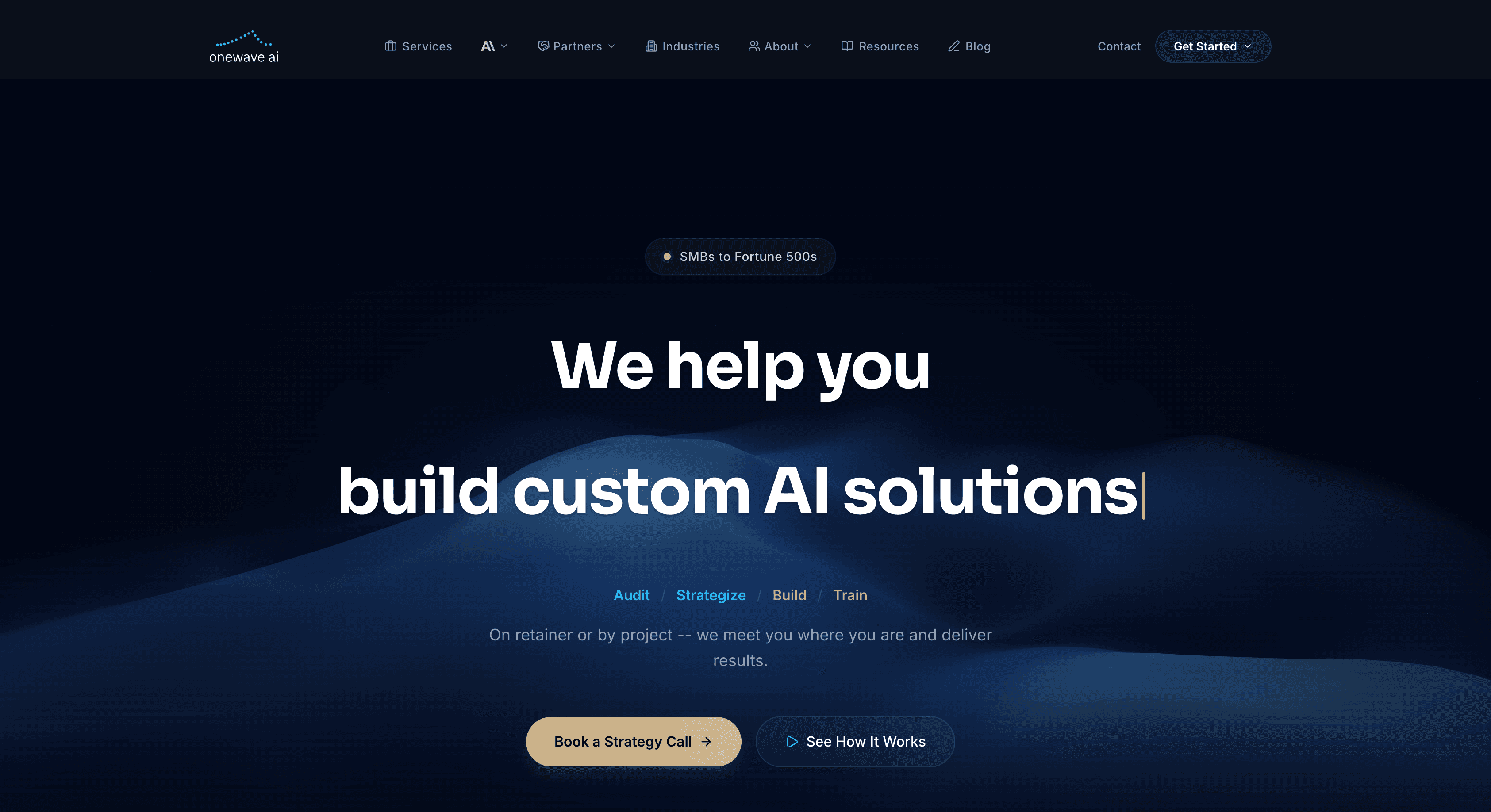
OneWave AI V1 - Original Wix template site from 2024

V1 -- Wix Template (2024)

Generic template. Canva logo. No SEO.

OneWave AI V2 - Replit-built site from early 2025

V2 -- Replit Custom (2025)

Darker look. Custom layout. Still fighting the tools.

OneWave AI V3 - Current site built with Claude Code in 2026

V3 -- Claude Code (2026)

Modern editorial design. Full SEO. Organic leads.

What Changed

Same team. Same budget. Completely different capability.

2024

x
Wix template used by thousands of other firms
x
Generic copy with no SEO strategy
x
Quick Canva logo that didn't stand out
x
No blog, no case studies, no content engine
x
Zero organic inbound leads

2026

Custom Next.js site with signature design language
SEO-optimized pages ranking on Google
Professional logo designed with Claude Code + Pencil.dev + Figma
Active blog, case studies, and resources driving traffic
Organic inbound leads from search and AI engines

Why We Share This

We tell this story because it's the same one we help our clients write. Derek at Nationwide Haul went from paying contractors for website changes to building his own CRM. Mike at Slidr went from zero code experience to running five AI agents. We went from a Wix template to a custom platform that generates leads.

The pattern is always the same: a capable team held back by tools that don't fit, learning to build what they actually need with AI. We had the AI skills and the business skills -- web design and development was the piece that AI enabled us to learn and do on our own. No one went to coding bootcamp. No one hired a freelance developer. We saved at least $50,000 on what agencies would have charged for the logo and site design alone.

And now we offer it as a service. The capability we built for ourselves became a capability we sell to others. That's the real ROI of learning to build with AI -- it doesn't just save money, it creates new revenue.

If we couldn't do this for ourselves, we wouldn't have the credibility to help anyone else. This site is the proof.

Frequently Asked Questions

Common questions about building websites with AI, based on our experience.

Can you build a website with Claude Code?

Yes -- and this site is the proof. Our team had zero frontend development experience when we started in 2024. We used Claude Code to build a fully custom Next.js application from scratch, deployed on Vercel. Over two years and three major redesigns (Wix to Replit to Claude Code), we went from a generic template to a modern platform that ranks on Google and drives organic inbound leads. No contractors, no agencies, no bootcamps.

How much does a custom website cost compared to hiring an agency?

We saved over $50,000 by building our site and logo with AI tools instead of hiring an agency. That covers what firms typically charge for logo design, site design, custom development, and ongoing maintenance. We used Claude Code for development, Pencil.dev and Figma for logo design, and Vercel for hosting. The total cost over two years was a fraction of a single agency engagement -- and we retained full control to iterate whenever we wanted.

Is AI better than Wix for building a business website?

For teams willing to learn, yes. We started on Wix in 2024 and the result looked identical to thousands of other consulting firms -- generic layout, no SEO strategy, limited customization. After switching to Claude Code and Next.js, we built a site with a unique design language, signature wave animations, full SEO optimization, an active blog, and case studies with real metrics. None of that was achievable on the template platform. The tradeoff is a steeper learning curve, but AI closes that gap fast.

How do you optimize a website for AI search engines?

Generative Engine Optimization (GEO) is about structuring content so AI-powered search engines can find, understand, and cite it. We publish case studies with specific metrics ($50K+ saved, 2-year timeline), write blog posts targeting long-tail keywords, add structured data like JSON-LD schemas, and make sure every page has clear, factual copy. By April 2026, our case studies were being cited by LLMs and our blog posts were ranking on page one of Google -- driving inbound leads from both traditional and AI-powered search.

Can a non-developer build a Next.js site with AI?

We did exactly that. Our team had strong development and business experience but no one specialized in frontend, web design, or graphic design before 2024. We progressed from Wix to Replit to Claude Code, learning as we went. By 2026, we were maintaining a full Next.js application with custom components, SEO-optimized pages, blog infrastructure, and deployment on Vercel -- all without hiring a frontend developer, web designer, or agency. The experience also became a new service offering: we now help other teams build their own platforms with the same approach.

Ready to Build Your Own?

Whether it's a website, a CRM, or an AI agent -- if your team can describe what they need, they can learn to build it. We'll show you how.