AI everywhere except the camera.
Missed what a proofing pass caught
A print magazine proof, July 1, 2026
Cut from a video project
His estimate on the first run, August 21, 2026
Design that used to go to an outside designer
Brand guides, proposals, social graphics, September 2026
Of one-at-a-time uploads, now a connector
His July baseline, built and tested by August
Filled the capacity that opened up
Now hiring another account manager, September 2026
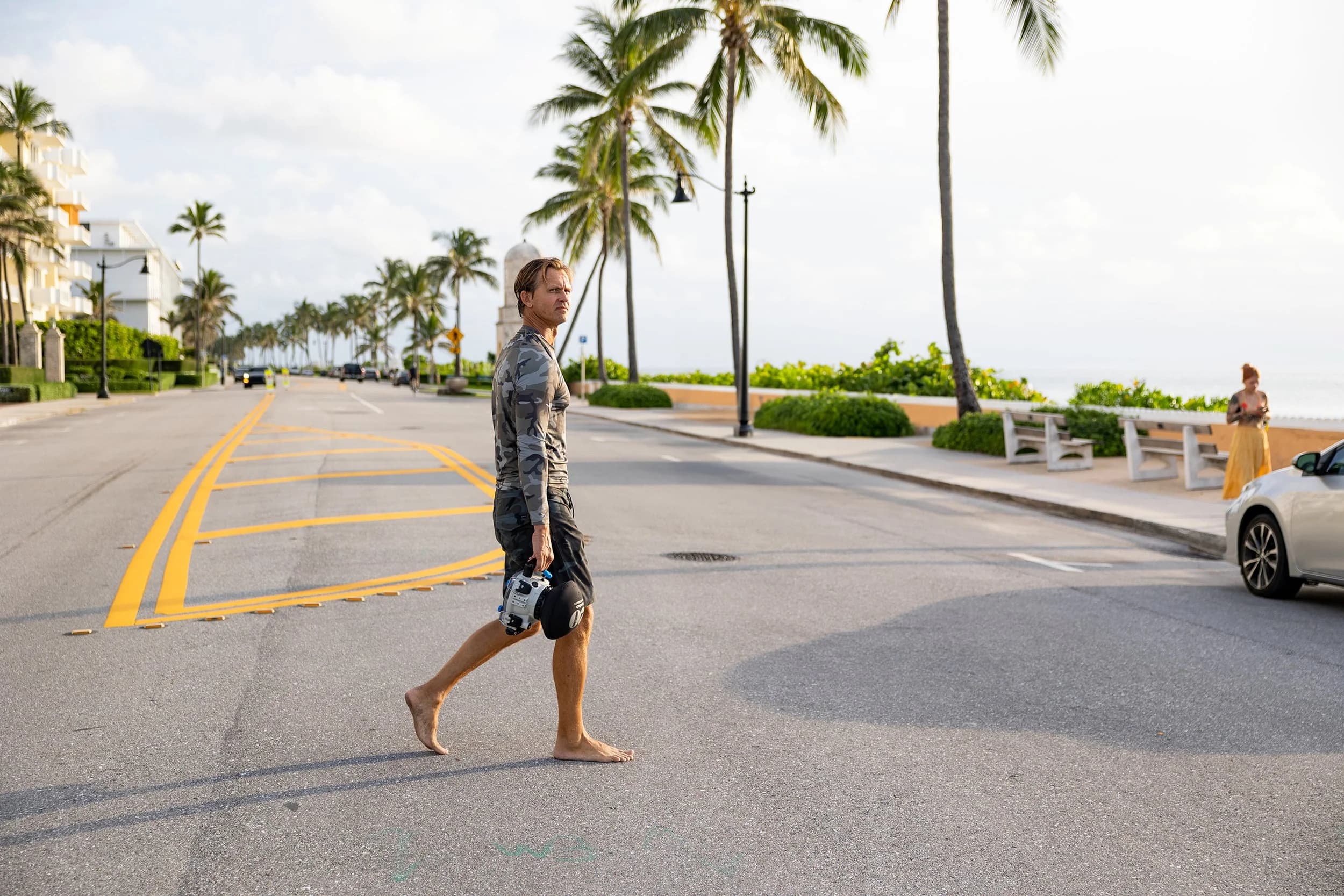
The work around the work.
Atlantic Current runs marketing accounts and publishes a free local magazine out of one building, with one team. The creative was never the bottleneck. Everything adjacent to it was.
Social publishing meant pushing 300-dpi images into Sprout Social one file at a time and waiting on each one — in July he put it plainly: “that step alone takes my employee several hours a week.” Video meant a talking-head interview where every false start had to be found by hand. And proofing the print magazine was, in his words, tedious, time-consuming work that needs a skilled person — usually him.
He already used AI daily. What he did not have was AI that knew anything about his accounts, which made it useless for an agency that sells voice.
Nothing that reaches a client looks generated.
Before any of the builds, Dustin set a constraint that shaped all of them. Atlantic Current is hired to show up and shoot real things — a chef cooking, a new location opening, a town on a Saturday. The magazine, he says, is “the no-AI zone. We keep it old school.” Generated imagery was off the table, and not as a matter of taste.
“We don’t want it to ever look like anything is generated. People have taken my photos and turned them into videos and they look pretty bad.” He now writes that restriction into his client contracts.
So the engagement went the other direction entirely. Every workflow we built sits around the craft — sourcing, proofing, assembling, captioning, scheduling, reporting — and none of it sits in the frame.
It caught what two editors missed.
The first result that landed was not a workflow. It was a PDF. Two weeks in, Dustin dropped a print proof of the magazine into Claude and asked for a thorough edit.
“It was finding stuff that two editors missed.” He had been using AI for a while and this was the one that registered: “that was pretty massive, because that is very tedious, very time consuming, you need a pretty skilled person to do — and usually that’d be me catching those things.”
It also set the pattern for everything after it. The task was judgment-heavy, unglamorous, and entirely behind the scenes — exactly the shape of work that turned out to be worth automating.
The tool that decided which AI they run.
The same week as the proof, Dustin took on a client who had a logo and nothing else — no brand guide, no system. He built the whole thing in Claude Design: “I used Claude Design to build out a full brand guide and it was pretty damn good.”
What he did next is the part worth copying. He deliberately constrained the output to things a human designer could pick up and run with — no exotic typefaces, nothing that locked the client in: “I wanted to make sure it was stuff any designer could pull from Canva or Adobe Express.” He was equally alert to the tells, watching for default fonts and the little circular icons that ring AI-made call-to-action buttons, and editing them out. Then he turned the capability into an offer: a brand guide as a launch-phase add-on for clients who had never had one.
From there it spread through the recurring work — the agency’s most-sent proposal rebuilt as a reusable template, social graphics, flyers. By September the turnaround was the argument: “in the time it would have taken me to message our designer to do it, I just did it in Claude Design.” His conclusion was that the agency “really shouldn’t have to outsource too much design.”
It also settled a decision he had been weighing for his entry-level hires, who arrive fluent in a different assistant: “I think Claude Design in itself is probably enough to get me to make that our company AI of choice.”
He is precise about where it stops. Print is still a gap — when a client asks for a table tent or a poster, “we can’t really print these files the way we would want.” High-resolution vector output is, in his view, the bridge still to be crossed, and Adobe remains where professional design finishes.
He described it in July. He shipped it in August.
Two asks came up early, and both were specific. On video: “if I could put in here’s A-roll, B-roll, all the audio for the interview, and it can do 90% of the work.” On social: “upload those photos, draft a first-pass caption based on the brand voice, and just save it as a draft. That could save a ton of time.”
We spent July working the architecture — connectors versus MCP, where the credentials live, what the security model has to be. He spent August building. By the 21st both existed. The video workflow ran against a real municipal account with the client’s annual reports loaded as context, pulled the filler and bad takes, and assembled the cut: “just the initial combing through of it saved me like three hours for that whole project.”
The Sprout connector shipped to his own security spec — approved images on an encrypted drive that is the only thing the workflow can touch, previewed in Claude, captioned by a per-client skill, saved as a draft, with analytics readable back out. On the first successful run: “I couldn’t believe it.” Both were saved as reusable skills so the next project starts from the finish line of the last one.
The skills stopped being his alone.
In August he did the thing that decides whether an engagement sticks. He took the daily brief skill he had built for himself, had Claude strip out his personal context and template it, and handed it to his right hand — with instructions to let Claude interview her and rebuild it around how she works.
“She’s so good at managing 50 different things at once. To have one place where you can see everything — that’s pretty huge.”
That handoff worked because of how he had been building all along. Every workflow that proved itself got saved as a reusable skill — the daily brief, a caption skill per client account, one for talking-head video and another for short-form reels, and the one that runs the newsletter. Asked in August whether the caption skills covered his book, his answer was “not all of them, but like enough.” The library is what made the work portable instead of personal.
His own version had already become load-bearing: “this and Claude in the last week has been massive” — a morning and afternoon brief across calendar, tasks, and mail that prioritizes against the time actually left in the day. He is candid that it still misses an email now and then. He uses it anyway.
A people problem is a good problem.
By September the capacity had a destination: new clients. Enough that the constraint moved off Dustin and onto headcount — the agency is bringing on another account manager.
He is careful about the cause and so are we. He credits the combination — AI, better systems, and one strong hire he can offload to without thinking twice. Not any one alone. What he will say flatly is the mechanism: “we probably have more information in one place on all of our clients than they have on themselves at this point.”
The capability is turning into new lines of business, too. He built a reusable hospitality template — Astra 6, ADA compliant, optimized for local and generative search — and is adding web design to keep that loop in-house. He is rebuilding Atlantic Current’s own site in Claude Code and retiring the Squarespace subscriptions behind it.
“All the free time I’ve been able to get through AI, I’ve just gotten new clients and filled it. It’s good bringing in more money — but now I’m hitting a bottleneck where it’s a people problem. It’s a good problem to have.”
How it came together.
Thirteen working sessions. He brought the obstacle, we worked the architecture, he built it and brought the next one back.
- 01June 15
Foundations, hands on
Projects, context, connectors, reusable skills, and where chat, Cowork, and Claude Code each fit.
- 02July 1
The magazine proof
A print PDF edited in Claude turns up errors two human editors missed. The first result that registered.
- 03July 1
A brand guide from a logo
A client with no brand system gets a full guide built in Claude Design, constrained so any designer could pick it up.
- 04July 7–17
The two specs
He names what he needs: 90% of a video edit from raw A-roll and B-roll, and captioned Sprout drafts from approved images.
- 05July 31
A build week compressed
He prototypes a client knowledge app with tools he had never used, covering what the plan called three weeks of work in a day.
- 06August 7
Handed to the team
His daily brief skill is templated, stripped of personal context, and passed to his right-hand employee to make her own.
- 07August 21
Both specs shipped
Video workflow saves about three hours on a real client project. The Sprout connector is built, tested, and locked to an encrypted drive.
- 08September 11
CRM and Marketing Brain
Source packages handed over so he can build his own reporting layer and leave per-seat CRM fees behind.
- 09September 18
Capacity spent
Freed time has become new clients. The next hire is an account manager, not an automation.
- 10Next
New website, then the CRM
Rebuilding the Atlantic Current site in Claude Code and retiring Squarespace, then migrating off GoHighLevel onto his own CRM with Sprout analytics in each client record.
Better systems. More room for clients.
Fourteen weeks in, AI sits in Atlantic Current’s proofing, video post-production, social publishing, client knowledge, and newsletter — and nowhere near a camera. The newsletter now searches the weekend’s events against his rules, pulls recent magazine articles, and formats the whole thing in beehiiv: “really don’t have to touch beehiiv at all. One of my employees just logs in, checks it, schedules a send.”
He is honest about the gap, too. Some workflows get 75% of the way there and the last 25% is still manual. The Sprout connector works but was not yet a daily habit. The July knowledge-base prototype was a prototype; the production client record still lived in running docs come September. These are client-reported figures from working sessions, not independently measured results.
Two builds are underway now. He is rebuilding the Atlantic Current website in Claude Code, splitting the agency from the magazine and retiring the Squarespace subscriptions behind both. And he is migrating off GoHighLevel — which he describes as still not fully set up and “pretty manual” — onto the CRM source package we handed over, with Sprout analytics reporting inside each client record.
Before
- 300-dpi images pushed into Sprout one file at a time, several hours a week
- Talking-head footage combed by hand for filler and false starts
- Print proofs read by whoever had time, usually Dustin himself
- Account facts spread across running Google Docs with no history
- Weekend events for the magazine newsletter sourced manually, by one person
His own account of the work, June and July 2026
With OneWave
- A connector that captions approved images and drafts them into Sprout
- Brand guides, proposals and social graphics made in-house, same day
- A video workflow that assembled a first cut about three hours faster
- A Claude proofing pass that caught what two human editors missed
- A full profile for every client, in one place
- A newsletter that researches, assembles, and formats itself in beehiiv
Built by Dustin during the engagement, reported September 2026
“The better your systems are, the better the AI is going to work. If you don’t have information on every account, AI is not going to perform as well.”
Start with the work you repeat every week.
Bring us a real workflow. We’ll teach your team the tools, build the process with you, and leave you running it.