

OpenAI for SMB and Business Use Has Never Been Better
For six months, it felt like Anthropic was running away with it.
Claude Opus 4.6 dropped in February with a million-token context window and Agent Teams. Claude Code kept eating developer workflows. Claude Cowork went from research preview to general availability, turning "agent" from a demo into something people actually use at work every day. The gap between Anthropic and everyone else looked real - and it looked like it was going to keep widening.
Then OpenAI pulled even.
Not with one launch. With five, in two weeks. And now - for the first time since mid-2025 - the race genuinely looks like a race again.
What OpenAI Just Shipped
OpenAI shipped GPT-5.4 on March 5 - the first general-purpose model with native computer use, a 33% reduction in factual errors, and 57.7% on SWE-bench Pro. Six weeks later, on April 23, they followed it with GPT-5.5.
But the model was almost the least interesting part.
On April 16, they pushed a major update to the Codex desktop app. Background computer use on Mac - Codex can see, click, and type across any app using its own sandboxed virtual cursor without stealing your focus. An in-app browser for frontend work. Over 90 plugins, including Atlassian, CircleCI, GitLab, Microsoft Suite, and Render. Built-in image generation. Memory that carries across sessions. And scheduling - agents that can pause mid-task, wait for a condition, and resume days later.
On April 21, they launched ChatGPT Images 2.0 - and it might be the single product that did the most to shift perception. This is not just another image model. It reasons first: plans the composition, searches the web for reference, double-checks its own output before generating. Up to 2K resolution. Multi-image generation with consistent characters across a set. Text rendering that actually works, including non-Latin scripts like Japanese, Korean, and Hindi.
DALL-E 2 and DALL-E 3 are being retired on May 12. That is how confident OpenAI is in this model. And they should be - it is the best image generation product on the market right now, and it is not particularly close. For businesses that need marketing visuals, product mockups, social content, or presentation graphics, this alone justifies a ChatGPT subscription. Anthropic has no answer for this yet.
And on April 23 - today - they rolled out Workspace Agents in ChatGPT. Codex-powered agents that plug directly into Slack, Google Workspace, Salesforce, Notion, and Atlassian. They run scheduled, multi-step workflows across your enterprise stack. OpenAI calls them the successor to custom GPTs, and they are not wrong.
Codex might be OpenAI's best product ever. And the company is showing why it is here to stay. ChatGPT is no longer carrying the whole company on its back - it is taking a seat next to a growing product lineup that, for the first time, matches the breadth of what Anthropic has been building.
Two Weeks That Changed the Race
April 8 - 23, 2026. Nine major launches from two companies.
Anthropic Has Been Doing the Same Thing From the Other Side
Anthropic's run is not over. Far from it.
Claude Cowork hit general availability on April 9 with enterprise features: RBAC, spend limits, usage analytics, OpenTelemetry support, and connectors for Google Drive, Gmail, DocuSign, and more. The same day, Managed Agents launched in public beta - a fully managed runtime where Claude can read files, run commands, browse the web, and execute code securely without you building your own agent loop. Notion, Rakuten, and Asana are early adopters.
A week later, Opus 4.7 arrived with high-resolution vision, task budgets for agentic loops, and a new reasoning tier. And the day after that, Claude Design launched - an Anthropic Labs product for creating slides, prototypes, one-pagers, and visual work. It reads your codebase to build a custom design system, and exports to PDF, PowerPoint, Canva, or directly to Claude Code for production implementation.
Claude Code Security, which launched back in February, is also worth noting. It found over 500 previously unknown high-severity vulnerabilities in production open-source codebases during internal testing. It is not a linter - it reasons about data flows, maps component interactions, and identifies business logic flaws.
The Gap Has Closed. Now It Is an Ecosystem Race.
Claude vs. ChatGPT was the debate of 2024. Anthropic vs. OpenAI ecosystems is the debate now.
Two weeks ago, Anthropic had a clear lead in product breadth. Today, both companies ship a frontier model, a coding product, an agent runtime, a design surface, scheduled workflows, and deep app integrations. The product lineups have converged in shape, even if they differ in philosophy and execution.
The Ecosystem Stack: Anthropic vs OpenAI (April 2026)
Both companies now ship a frontier model, a coding product, an agent runtime, a design surface, and deep integrations.
At Most Companies, the Answer Is Both
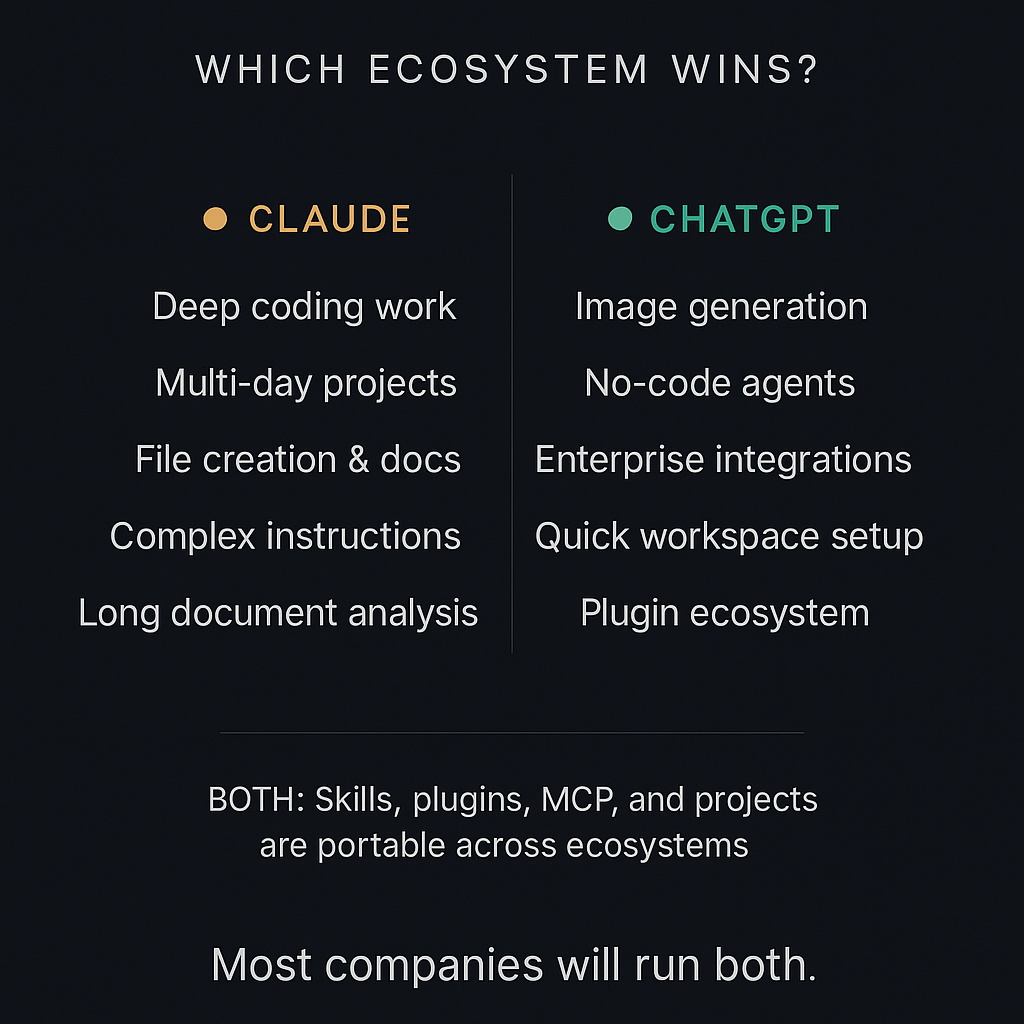
Here is the part most of the "which one wins" takes miss: at almost every company we work with, the answer is both.
Images, broad agent building, and the out-of-the-box workspace experience: ChatGPT is easier and often better right now. Workspace Agents are the fastest path from "idea" to "running workflow" for a non-technical team. The image model is genuinely best-in-class. The plugin ecosystem is mature.
Cowork, file creation, long-horizon collaboration, deep coding work: Claude is ahead. Claude Code is still the best agentic coding tool available. Cowork handles multi-day projects with file access and shell execution. Claude Design turns a design into a prototype into production code without leaving the ecosystem.
Smart teams are not picking a side. They are running them alongside each other and using each as a fallback for the other when one is down, rate-limited, or just not the right tool for the job.
Where Each Platform Wins Today
Smart teams run both and use each as a fallback for the other.
| Capability | Leader |
|---|---|
| Image Generation | ChatGPT |
| Agent Building (no-code) | ChatGPT |
| Coding & Dev Workflows | Claude |
| Long-horizon Collaboration | Claude |
| File Creation & Docs | Claude |
| Design & Visuals | Even |
| Plugins & Integrations | ChatGPT |
| Skills / Plugin Portability | Even |
The Infrastructure Genuinely Carries Over
And the good news: the primitives are converging.
Skills and plugins exist natively in both Claude and ChatGPT - the concept is the same. MCP connectors port across for the most part, especially now that MCP lives under the Linux Foundation with broad industry backing. Projects are projects. Cowork agents and Workspace Agents are the same idea with different UIs. A skill you build in one ecosystem runs in the other. A team that is fluent in one can leap to the other without starting over.
This is not about human skills transferring. The actual technical artifacts - the skills, the plugins, the connectors, the agent configurations - are directly portable. The standards are converging.
The Frontier Model Is the Commodity
Here is what the last 18 months have actually taught us: it was never really about whose model is smarter.
The benchmarks trade hands every few weeks. GPT-5.5 just launched and it will top some charts until Claude Opus 4.8 or 5.0 tops them back. What does not trade hands is the product. The UI of the ChatGPT app. How the new Codex feels to live in. How Cowork handles a multi-day project. The design of the product around the model.
The frontier model is the commodity. The ecosystem is the moat. Your team's AI fluency is the compounding asset.
And most companies will end up fluent in two ecosystems, not one.
What This Means for Your Business
The SMBs and mid-market teams getting the most out of AI right now are not the ones picking the "best" model. They are the ones picking an ecosystem - or two - building thoughtful workflows and agents inside it, and letting that work compound.
If you are just getting started, here is the practical advice:
- Start with one ecosystem - whichever your team gravitates toward. Both are production-ready for business use.
- Build skills and agents rather than just chatting. The value compounds when you create reusable workflows.
- Know when to reach for the other one. Need images? ChatGPT. Deep coding work? Claude Code. Scheduled enterprise workflows? Workspace Agents. Multi-day file-heavy collaboration? Cowork.
- Train your team on the primitives - skills, plugins, MCP, projects, agents - not on a specific product. The concepts are the same; only the UI changes.
The race between Anthropic and OpenAI is making both ecosystems better, faster. The companies that benefit most are the ones building on top of both.
OneWave AI is a certified partner of both OpenAI and Anthropic. We help SMBs and mid-market teams adopt AI across both ecosystems - from strategy and training to custom agents and automation. Get in touch or book a free call.